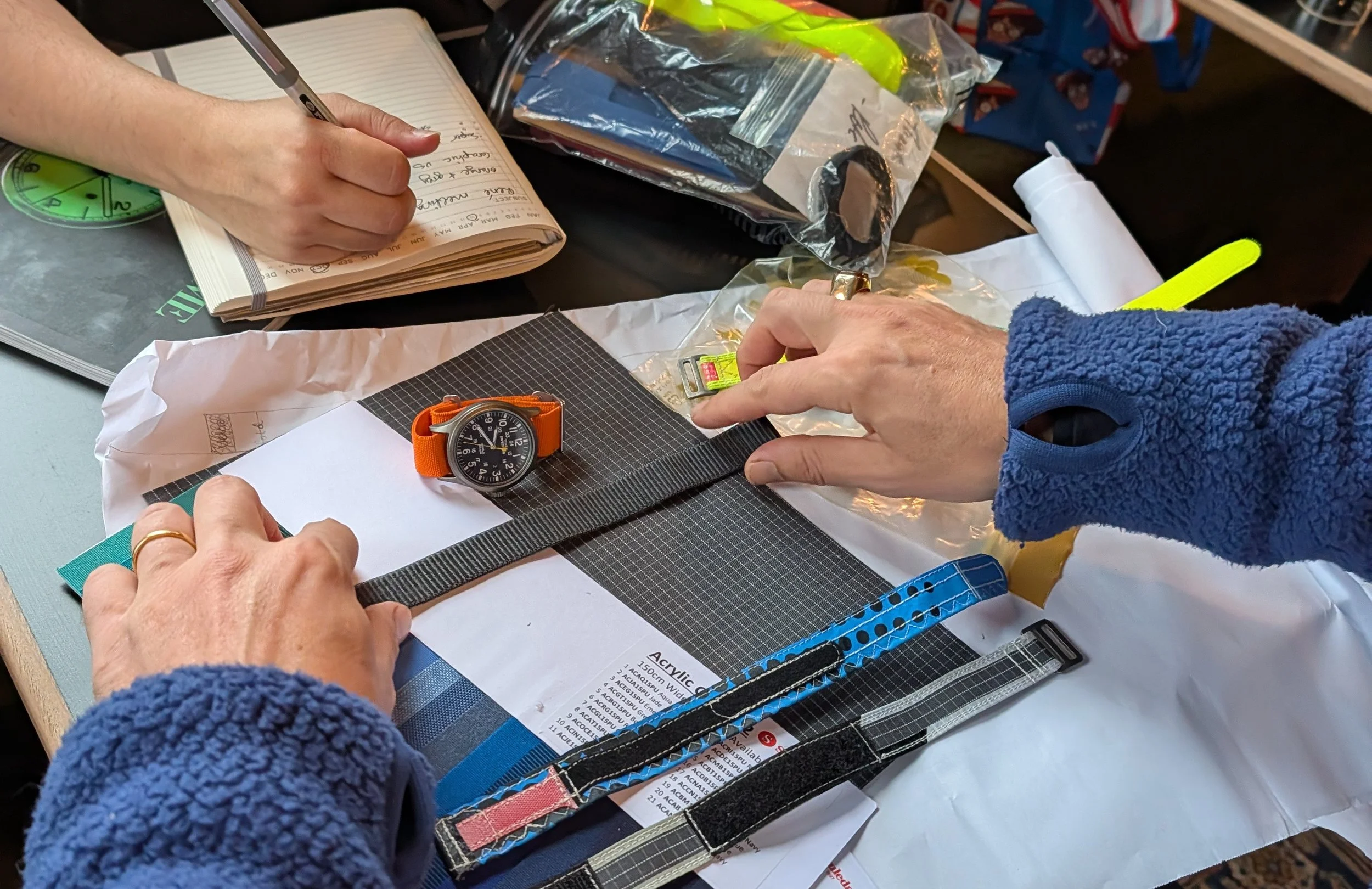
Prototyping Round one.

Before you can start anything, you need a team. Or at least in my situation, someone who knows which end of a sewing machine is which. That was my first problem, outside of a friend or two I didn’t really know anyone who could help me get the first version of prototypes off the ground?
Finding a team
As usual, it started with talking to my extended network of friends around me, and as it turns out one of my “school dad” friend’s happened to be fairly connected at Arts University Bournemouth, which for those who don’t know, it’s a place where design, textiles, craft and creativity are pretty much the daily language. After a bit of persuasion he introduced me to the head of the Fashion and Design department, who then introduced me to Kelsey.
Kelsey’s an MA student from California but before that she spent years in industry actually making things, and more importantly, knowing how to stitch them so they do not fall apart on day two. After a couple of chats we met in person and clicked immediately. She understood the journey, the idea, the purpose and the potential straight away. Since that first meeting she has been my go-to for all things prototyping. It helps that she is one of the most positive, creative people you could hope to work with. From my years in tech start ups I cannot tell you how important that kind of attitude is, it changes everything.
The materials hunt
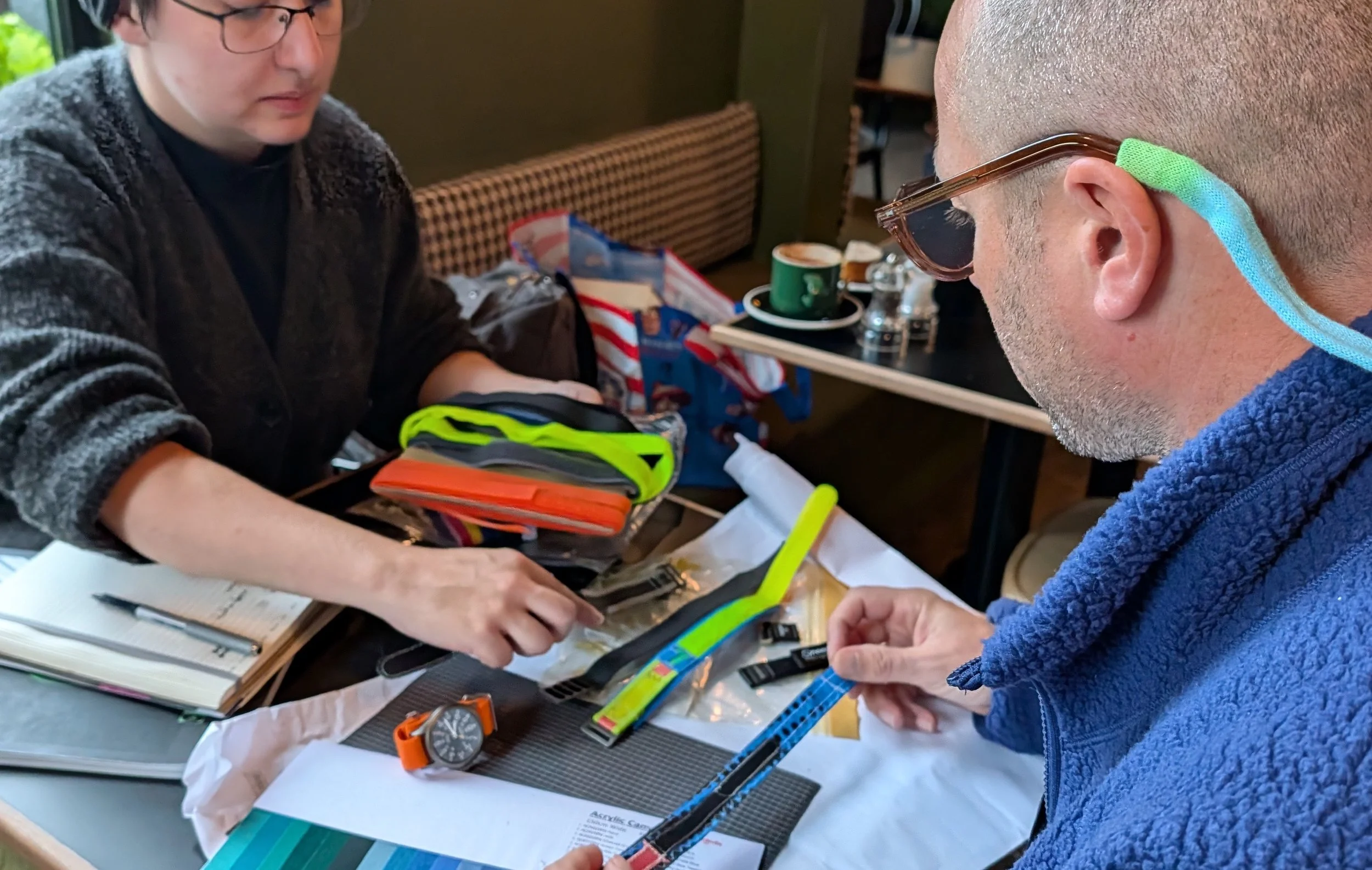
Next on the hit list were the materials. I always knew recycled sails were going to be the foundation, so I started by asking for donations from friends. As you can imagine, you get what you are given. Some were interesting, some were… less so. So I started sourcing them myself, buying from eBay, speaking to sailors, and lurking around Poole’s sailing and watersports clubs. This worked a little too well because before long I had enough sailcloth to cover half of England. Sails are enormous. Great news for yachts, less helpful when your end product is a watch strap about two centimetres wide.
Another challenge was the decals. A number on a spinnaker might look striking from across a bay, but scaled down to strap size it often disappears completely. Then I started looking at kitesurf sails. Living in Poole helps, the bay is shallow and the kitesurf scene is huge. These sails have brilliant colours, graphic panels and far more character in smaller sections.
Kitesurf sails mixed with bold spinnaker fabrics created something that kinda felt right. But I also wanted to think bigger. Poole is full of sailmakers so I started reaching out, explaining the idea and seeing if anyone would be open to helping.
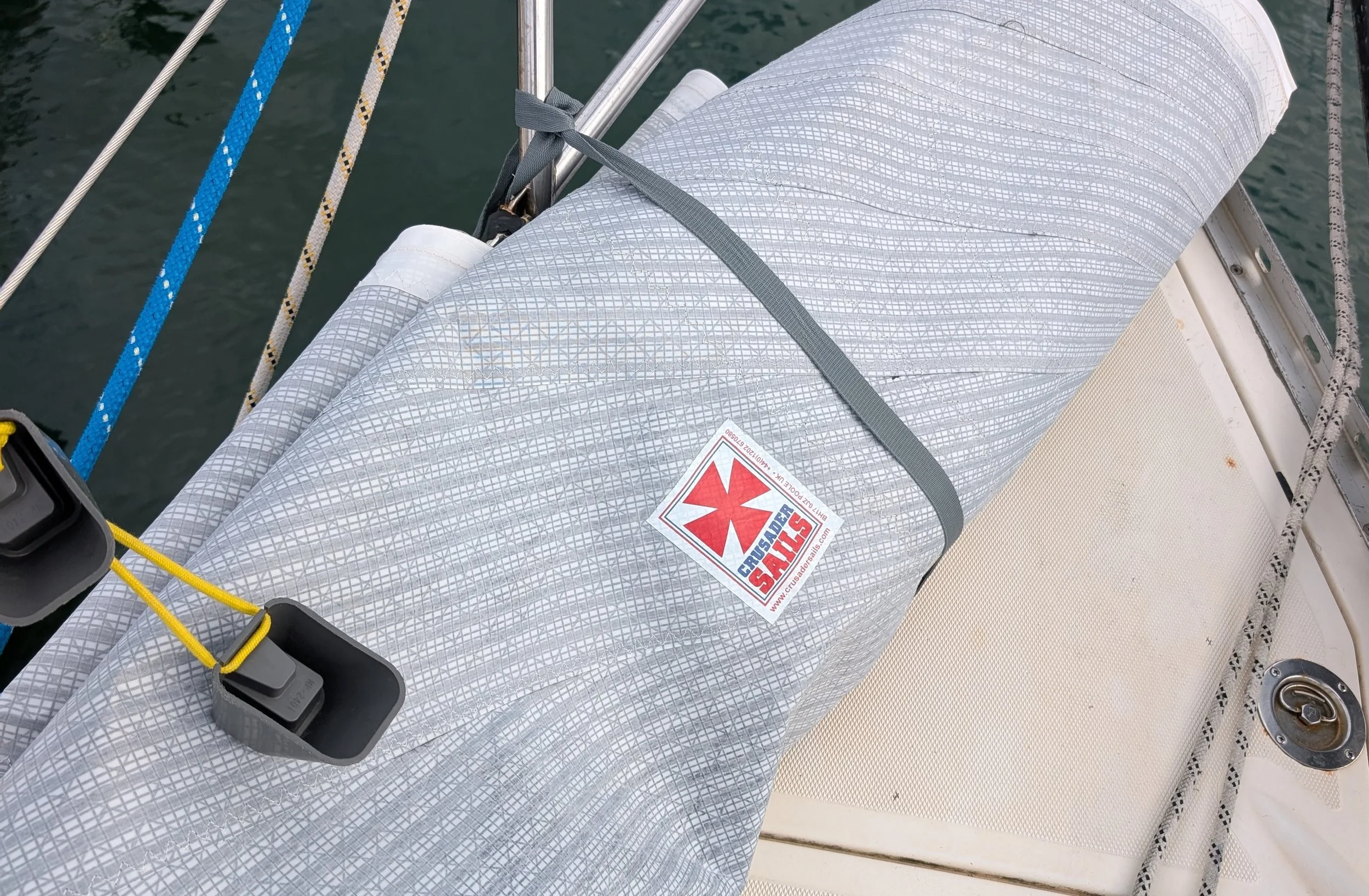
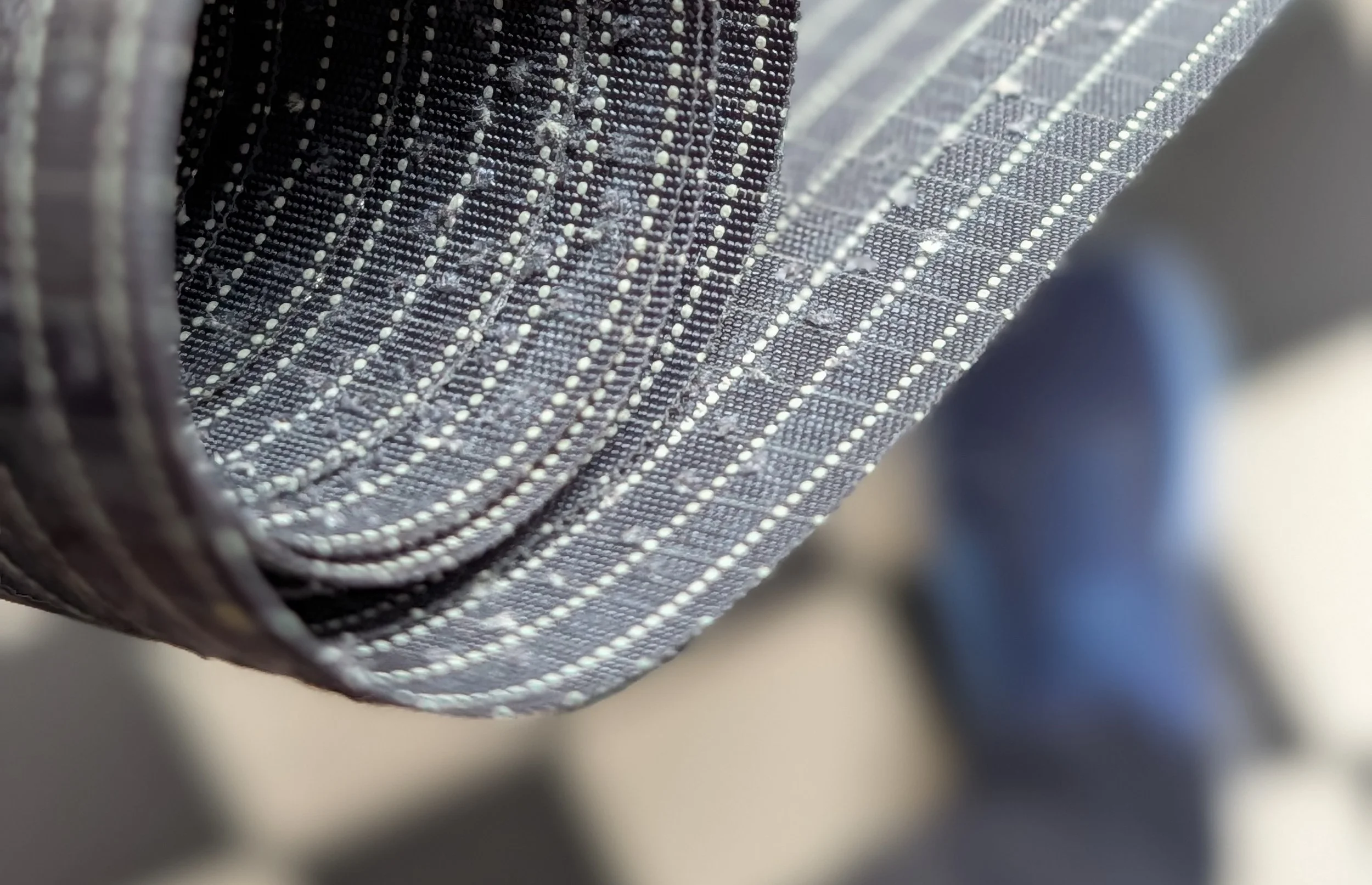
Crusader Sails were at the top of the list. They made the original jib sail that inspired this whole project so it felt right to start there. I met Andy Cross who showed me around the workshop, walked me through materials, explained the different types of sail construction, and basically gave me a crash course in a craft that borders on aerospace engineering at times. The composite materials used for racing sails are astonishing. Ultra tough, ultra light, ultra flexible.
He also told me about offcuts. Small pieces left over from sails produced for yachts racing in things like the Fastnet. These materials can cost tens of thousands to manufacture, so the fact that Andy was willing to donate a few pieces towards the prototypes was unbelievable.
It sparked the question, could I combine used sails with premium racing offcuts to create something special? At this point it was back to Kelsey to figure out what was actually feasible.
Looking at what already exists
Of course we had done our research. I went back to the watch straps I loved as a kid, especially those old 1990’s Animal straps. I also looked at the more rugged military style straps you find in surplus shops around Poole. They had charm but they were bulky and, in the context of what I wanted, over engineered.
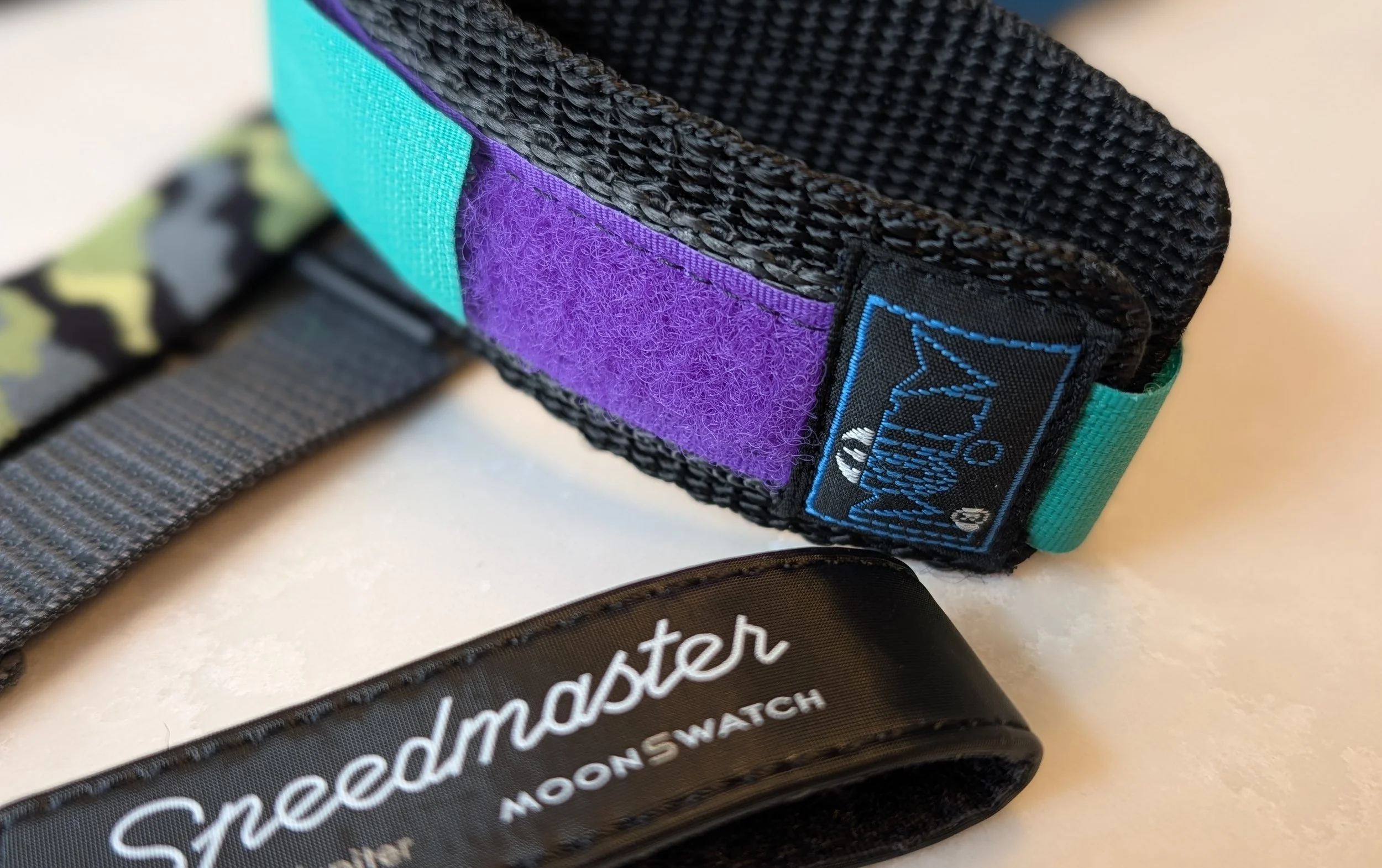
Our challenge was to design something that felt modern and refined, yet tough enough to live a real life, whether that is sailing, hiking, or just getting dragged through daily use. We started sketching out ideas and answering some fairly basic but important questions.
Would it fit multiple wrist sizes?
Would it work on smart watches as well as mechanical watches?
How do we make it look good and still feel comfortable?
Plenty of questions, plenty to figure out.
Prototype round one
Once we had enough ideas floating around, it was time to hand everything over to Kelsey and see what could actually be made. Two weeks later, here we are heading into Prototyping round one.
The first physical version(s) of the Loop Strap exists. It is early, it is rough in places, and there are details we will refine for months, but it is real. And seeing something that started as a conversation, became a sketch, then a material, and finally a physical object is one of the most exciting parts of the entire journey.
More to come.